

Each foot is made up of two toes (the third and fourth digits) which have a toenail and pad. The toenails extend off the front of each toe and curve to point towards the ground. The toenails will need to be trimmed occasionally if the llama does not wear them down naturally.
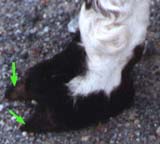 | 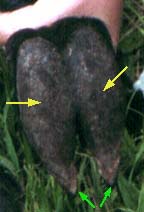 |
Most of the bottom surface of the foot is composed of the pad. The pad is very similar to a dog's pad. The llama's pad is larger and not quite as rough as a dog's. This pad enables llamas to have more sensation and better contact with the ground than any animal with hooves, thus making them more sure-footed. Since the pad is softer than a hoof, llamas cause much less damage to the environment. It will take a llama much longer to wear a path than a horse, cow, sheep or goat.
The llama has three phalanges per digit just like in our own fingers and toes. The second (P2) and third (P3) phalanges are parallel to the ground to provide the framework for the foot. Unlike many other livestock who only walk on the third phalanx (P3), llamas walk on both the second phalanx (P2) and the third phalanx (P3). The first phalanx (P1) is at a 45 to 50 degree angle with the ground. This bone emerges from the foot to make up the pastern. It creates the fetlock joint when it meets the metacarpals (front limbs) or metatarsals (hind limbs).
The structure of their feet is part of what gave llamas an important role in ancient South American society and is creating a use for them now. Llamas are regularly used for packing by hikers, campers and hunters. Some park rangers are now using llamas as pack animals for park maintenance because they can go more places than mules and do less damage in the process.
Last updated April 16,1997
 |
 |